



Why Do Thais Tell Time Differently?
The Fascinating Story Behind Mong, Thum, and Tee
Have you ever heard a Thai person say “2 ทุ่ม” (song thum) and wondered what time that actually means?
If you’re familiar with the international 12-hour or 24-hour clock, you might find the Thai way of telling time a little confusing at first.
For example, when Atom says “2 ทุ่ม” (song thum), she means 8:00 PM, not 2:00 PM.
But why do Thai people call 8:00 PM “two thum”?
The answer takes us back centuries, to a time when clocks were not widely available and people relied on the sounds of gongs and drums to know the time.
A Timekeeping Tradition Rooted in Sound
Long before modern clocks became part of everyday life, traditional Thai communities used audible signals to announce the passing hours.
Gongs and drums played an important role in public timekeeping, particularly in historical administrative and royal settings.
Over time, the sounds and actions associated with these instruments became connected to the words Thai people use to tell time.
Even today, these expressions remain a natural part of everyday conversations.
Let’s explore how they work.
🌝 Daytime: The Sound of the Gong — “Mong” (โมง)
The Thai word “mong” (โมง) is traditionally associated with the sound of a gong.
A gong, known in Thai as “ฆ้อง” (khong), is a percussion instrument made from metal, often a copper-based alloy. It produces a rich, resonant sound when struck with a mallet.
The sound is traditionally represented as “mong… mong…”, which is associated with the Thai word used in daytime time expressions.
Here are some examples:
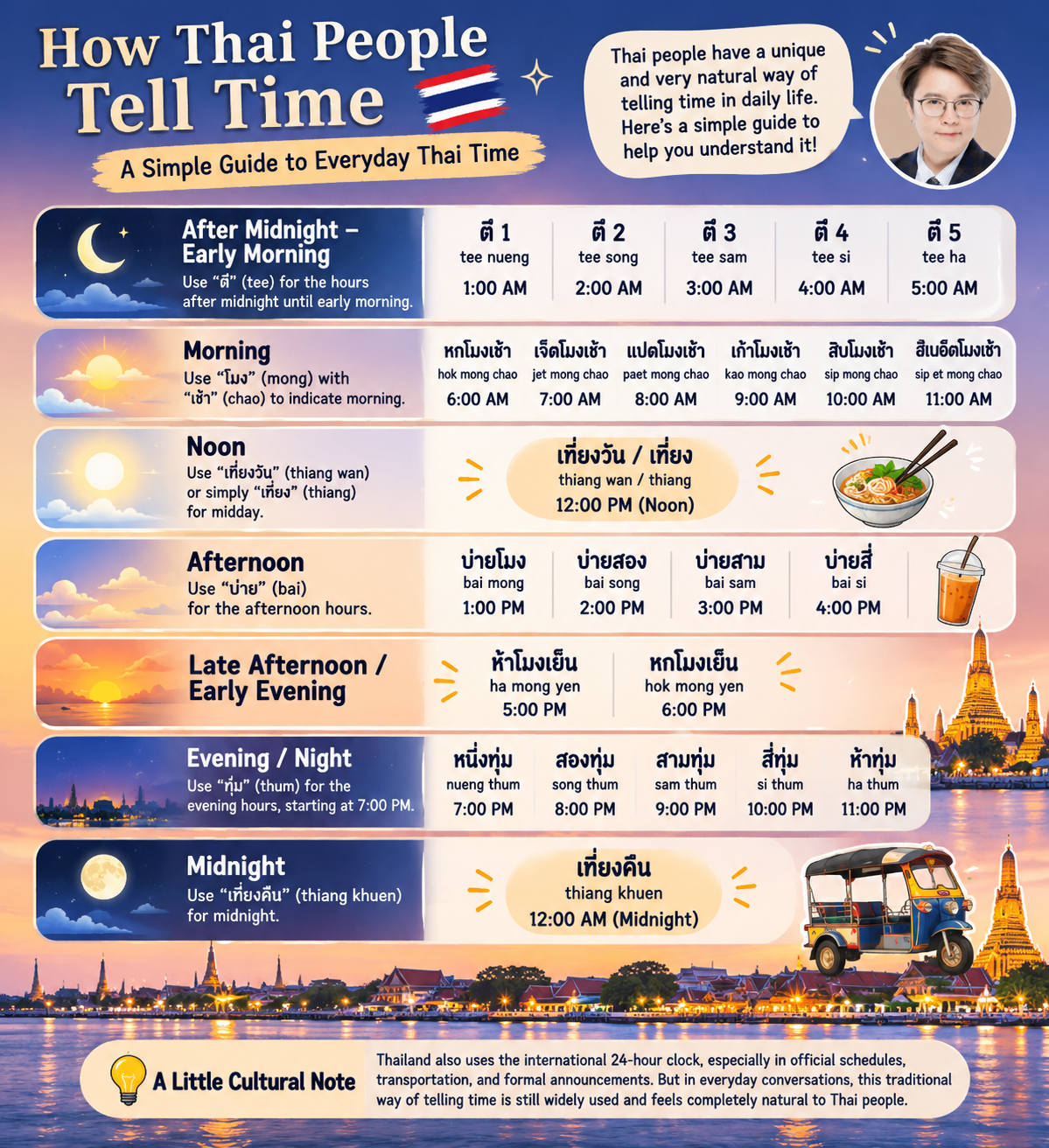
| Thai Expression | English Time |
|---|---|
| หกโมงเช้า (hok mong chao) | 6:00 AM |
| เจ็ดโมงเช้า (jet mong chao) | 7:00 AM |
| แปดโมงเช้า (paet mong chao) | 8:00 AM |
| เก้าโมงเช้า (kao mong chao) | 9:00 AM |
| สิบโมงเช้า (sip mong chao) | 10:00 AM |
| สิบเอ็ดโมงเช้า (sip et mong chao) | 11:00 AM |
| เที่ยง (thiang) | 12:00 PM (Noon) |
Interestingly, the Thai system changes again after noon.
From 1:00 PM to 3:00 PM, Thai speakers commonly use “บ่าย” (bai), meaning afternoon, followed by the hour.
For example:
- 1:00 PM = บ่ายโมง (bai mong)
- 2:00 PM = บ่ายสอง (bai song)
- 3:00 PM = บ่ายสาม (bai sam)
Later in the afternoon, the expressions change again:
- 4:00 PM = สี่โมงเย็น (si mong yen)
- 5:00 PM = ห้าโมงเย็น (ha mong yen)
- 6:00 PM = หกโมงเย็น (hok mong yen)
The word “yen” (เย็น) refers to the late afternoon or evening.
🌛 Evening: The Sound of the Drum — “Thum” (ทุ่ม)
As the day turns into night, Thai time expressions shift from “mong” to “thum” (ทุ่ม).
The word “thum” is traditionally associated with the deep, low sound of a drum being struck.
Imagine the sound echoing through a quiet town at night:
Thum… thum… thum…
These drumbeats were historically used to announce the hours after sunset.
This is where the Thai evening time expressions come from.
| Thai Expression | English Time |
|---|---|
| 1 ทุ่ม (nueng thum) | 7:00 PM |
| 2 ทุ่ม (song thum) | 8:00 PM |
| 3 ทุ่ม (sam thum) | 9:00 PM |
| 4 ทุ่ม (si thum) | 10:00 PM |
| 5 ทุ่ม (ha thum) | 11:00 PM |
So, when Atom says “2 ทุ่ม”, she is simply referring to 8:00 PM.
It’s a completely natural expression in Thailand, even though it may sound unusual to someone learning Thai for the first time.
But What Happens at Midnight?
Here comes an interesting exception!
Following the evening pattern, you might expect midnight to be called “6 ทุ่ม” (hok thum), meaning “six thum”.
But Thai people don’t normally say that.
Instead, we use “เที่ยงคืน” (thiang khuen), which means midnight.
The word “thiang” (เที่ยง) is also used for noon, while “khuen” (คืน) means night.
So Thai has two special expressions:
- เที่ยง (thiang) = 12:00 PM (Noon)
- เที่ยงคืน (thiang khuen) = 12:00 AM (Midnight)
🌤️ After Midnight: “Tee” (ตี)
Once midnight has passed, Thai time expressions change again.
From 1:00 AM to 5:00 AM, we use the word “tee” (ตี).
In Thai, “tee” literally means “to strike” or “to beat”.
Like “thum”, the term is connected to the historical practice of striking a timekeeping instrument to announce the hours during the night.
Here is how it works:
| Thai Expression | English Time |
|---|---|
| ตีหนึ่ง (tee nueng) | 1:00 AM |
| ตีสอง (tee song) | 2:00 AM |
| ตีสาม (tee sam) | 3:00 AM |
| ตีสี่ (tee si) | 4:00 AM |
| ตีห้า (tee ha) | 5:00 AM |
At 6:00 AM, we return to “หกโมงเช้า” (hok mong chao), beginning another daytime cycle.
A Quick Guide to Thai Time
Here’s a simple way to remember the traditional Thai time expressions:
| Time Period | Thai Expression |
|---|---|
| 1:00 AM – 5:00 AM | Tee (ตี) |
| 6:00 AM – 11:00 AM | Mong chao (โมงเช้า) |
| 12:00 PM | Thiang (เที่ยง) |
| 1:00 PM – 3:00 PM | Bai (บ่าย) |
| 4:00 PM – 6:00 PM | Mong yen (โมงเย็น) |
| 7:00 PM – 11:00 PM | Thum (ทุ่ม) |
| 12:00 AM | Thiang khuen (เที่ยงคืน) |
These are common conversational patterns, although Thai speakers also use other expressions depending on the context.
More Than Just a Way of Telling Time
What makes the Thai timekeeping system so fascinating is that it reflects much more than a method of counting hours.
It preserves traces of a time when sound played an important role in organizing daily life.
The traditional associations between gongs, drums, and time expressions offer a glimpse into Thailand’s linguistic and cultural heritage.
While the precise historical development of these expressions is more complex than a single origin story, their connection to traditional timekeeping remains an interesting part of Thai cultural history.
Today, Thailand uses modern clocks and the 24-hour system in official schedules, transportation, business, and many other settings.
Yet in everyday conversations, people still naturally say “สองทุ่ม” instead of “20:00”.
And that’s the beauty of language.
Sometimes, the words we use every day carry echoes of the past, even when we no longer notice them.
So, the next time you hear a Thai person say “2 ทุ่ม”, you’ll know that it means 8:00 PM.
And perhaps you’ll also imagine the distant sound of a drum, echoing through a Thai town centuries ago.
Learning a language isn’t just about understanding words. It’s also about discovering the history, traditions, and ways of life hidden within them.